Wednesday, March 23, 2011

Discover where $10 can take you... Pure Michigan Travel: http://bit.ly/gPW0Ja http://amplify.com/u/bw4u4
Wish our governor would see the error of his ways in taking away the tax incentives that would bring so much more opportunity for work. http://detnews.com/article/20110322/ENT02/103220305/Ready-for-your-long-shot http://amplify.com/u/bw4pi
Thursday, March 17, 2011
RIP Richie...
Don't forget to tell your friends how much they mean to you, for one day they may no longer be with us... Rest in Peace, Richie... Selfishly I wish you would answer your phone one more time, saying "Big Dick's Half Way Inn..." http://amplify.com/u/bv1ft
Monday, March 14, 2011
Thursday, February 17, 2011
There snow beesness, like show beesness...
I woke to a wet dream this morning, merely due to this warm front that moved in and started to melt all the snow. It's 9:00 am and already 50 degrees this morning, with the sunshine on my face I'm excited to see spring right around the corner. As the water continues to accumulate in the valley of my sidewalk, I must tread the water and remove as much as I can to make it safe for the kids passing by after school this afternoon. In doing so I was distracted by a few of my honeybees that had stopped to gather water from the early thaw. I was so overjoyed to get the first glimpse of possible survivors of last summers swarm season, I quickly finished clearing the walk and headed out back to check out the hives.
It looks as if 3 of the 12 hives in this apiary have survived the harsh Michigan winter. I'm thankful, as that is better than some of the winters in recent years. I was so excited I had to run in the house and grab my Canon Rebel in order to document this wondrous occasion and get some photos of the bees in the snow before it melts.
Enjoy some of these photos:
It looks as if 3 of the 12 hives in this apiary have survived the harsh Michigan winter. I'm thankful, as that is better than some of the winters in recent years. I was so excited I had to run in the house and grab my Canon Rebel in order to document this wondrous occasion and get some photos of the bees in the snow before it melts.
Enjoy some of these photos:
Friday, December 17, 2010
Started this article in 2005
More beekeepers need to migrate themselves away from, and their bees off of man made foundation that have been sized incorrectly.
in reference to: Natural Cell Honeybees - a knol by Kevin Tuttle (view on Google Sidewiki)Wednesday, September 29, 2010
Monday, September 27, 2010
Monday, July 21, 2008
Happy Birthday Buckshott...
Happy Birthday wishes go out to my son Drew. I wish I was there...
We should get together and have a few beers... Oh wait, your only Fifteen, sorry I'll have to drink your share since you're not of legal age yet. I know somewhere, someone will consume a few Black Label Light's for you...
For all you do... this Bud's for you... when your old enough to drink it Buckshott, the King of Kids... Have a happy day...
Monday, June 30, 2008
New Hudson Swarm @ The Edwards Family
Gina Edwards called me this morning with a great deal of concern in her voice, she thinks she has bees getting in her house underneath the siding. It sounded as if they might be yellow jackets hanging around, but shortly thereafter this swarm of honeybees appears.

I will finish this story later...

I will finish this story later...
Sunday, June 29, 2008
Tuesday, May 01, 2007
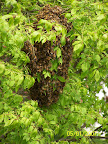
Elisabeth's swarm @ Woodhaven location
The best call for a beekeeper to receive on May 1st... a swarm has landed.
Monday, September 19, 2005
Wednesday, September 07, 2005
Hillbilly PBH
This is an experiment inspired by inquiring minds of other beekeepers, and to satisfy my own curiosity of a phenomenon I had never bothered to ponder.
This is the honey on bread project, Code Name: Hillbilly PBH("Hillbilly" brand, whole wheat Peanut Butter & Honey)
I normally assemble my sandwich right away, first spreading the PB on one half then honey on the other half and jam the two slices together, but don't like the honey dripping down my hand, so I had an idea to apply the honey first, allowing it time to soak in as I spread the PB on the other half. It looked to have soaked into the slice of bread as I had finished slathering the other half with the PB, problem solved, no more honey dripping.
As I consumed my masterpiece, I noticed a crunchy type texture to my sandwich, of which consisted of creamy PB, Great Lakes Honey, and "Hillbilly" whole wheat bread. I didn't think much of it at the time, then as I browsed my Honeybee forum at Beesource.com, I stumbled upon a thread that was inquiring as to why honey on bread gets crunchy, hence, I will have to endure the grueling task of performing the experiment. Unfortunately, this will consist of forcing me to consume yet another few sandwiches consisting of this god-awful concoction, purely for the sake of science of course.
The experiment:
Step One: The control subject of the experiment.
I took two slices of fresh "Hillbilly" bread as in my previous endeavors, applied creamy PB to the first half of the first sandwich, applied my Great Lakes Honey to the other half, assembled and consumed. I also had a full glass of milk next to me to clean my pallet and make sure there was no cross contamination or taste interference from the previous bite, also used as a safety feature in case I had to rinse down some peanut butter that may get stuck in my throat.
Result:
Taste: was tastefully sweet and wonderfully pleasing to the pallet
Aroma: was sweet as a field in full bloom, with a soft accent of legume and a field of wheat
Texture: was moist, smooth and creamy, yet a bit gooey. As a matter of fact, so gooey I had to follow each bite with a swig of milk.
Overall: A little disappointing as it was not very filling.
Step Two: The test subject.
I took two more slices of fresh "Hillbilly" bread as I had done in the control experiment, this time however; I applied my Great Lakes Honey first. Then I slathered the other half of the subject with the PB, being meticulous about getting the PB right to the edges of the slice as I always do. I then inspected the slice that had my Great Lakes Honey applied to, not more than a minute prior. The honey appeared to have soaked into the slice of bread, leaving a slight film on the surface. After closer inspection, this film left on the surface had a hard glaze to it. The slice of bread was still flexible, yet the honey left on the surface was firm, no longer liquid. I still had to dredge on and continue the experiment, so I assembled the two slices and consumed as before.
Result:
Taste: was still as pleasantly sweet and wonderfully pleasing to the pallet
Aroma: was sweet as a field in full bloom, with a soft accent of legume and a field of wheat
Texture: was moist, smooth and creamy, and a slight bit gritty. Yet, not so gritty that I had to follow each bite with a swig of milk in order to rinse the crystals of what seemed to be sugar out of my mouth, but I did take a swig after each bite to rinse the creamy film left behind by the PB. Only to continue in the same manner as I had in the control experiment, and have a nice clean pallet for full evaluation of the next bite without any contamination from the previous.
Overall: Surprisingly enough this sandwich was much more filling than the first, for the sake of science I'm glad I had not consumed this experiment first, because I would not have had enough room for the first experiment and the two glasses of milk needed to conduct this test properly.
My conclusion is inconclusive at best, and will need further research, which will have to be reserved for a later time, as I have to wait for the crowded lab to evacuate.
One valuable lesson I will take from this experiment: I will never consume that second sandwich first, as the reaction that occurred between the bread and caused the honey to glaze over and become stiff, also created a much heavier subject to be consumed.
This is the honey on bread project, Code Name: Hillbilly PBH("Hillbilly" brand, whole wheat Peanut Butter & Honey)
I normally assemble my sandwich right away, first spreading the PB on one half then honey on the other half and jam the two slices together, but don't like the honey dripping down my hand, so I had an idea to apply the honey first, allowing it time to soak in as I spread the PB on the other half. It looked to have soaked into the slice of bread as I had finished slathering the other half with the PB, problem solved, no more honey dripping.
As I consumed my masterpiece, I noticed a crunchy type texture to my sandwich, of which consisted of creamy PB, Great Lakes Honey, and "Hillbilly" whole wheat bread. I didn't think much of it at the time, then as I browsed my Honeybee forum at Beesource.com, I stumbled upon a thread that was inquiring as to why honey on bread gets crunchy, hence, I will have to endure the grueling task of performing the experiment. Unfortunately, this will consist of forcing me to consume yet another few sandwiches consisting of this god-awful concoction, purely for the sake of science of course.
The experiment:
Step One: The control subject of the experiment.
I took two slices of fresh "Hillbilly" bread as in my previous endeavors, applied creamy PB to the first half of the first sandwich, applied my Great Lakes Honey to the other half, assembled and consumed. I also had a full glass of milk next to me to clean my pallet and make sure there was no cross contamination or taste interference from the previous bite, also used as a safety feature in case I had to rinse down some peanut butter that may get stuck in my throat.
Result:
Taste: was tastefully sweet and wonderfully pleasing to the pallet
Aroma: was sweet as a field in full bloom, with a soft accent of legume and a field of wheat
Texture: was moist, smooth and creamy, yet a bit gooey. As a matter of fact, so gooey I had to follow each bite with a swig of milk.
Overall: A little disappointing as it was not very filling.
Step Two: The test subject.
I took two more slices of fresh "Hillbilly" bread as I had done in the control experiment, this time however; I applied my Great Lakes Honey first. Then I slathered the other half of the subject with the PB, being meticulous about getting the PB right to the edges of the slice as I always do. I then inspected the slice that had my Great Lakes Honey applied to, not more than a minute prior. The honey appeared to have soaked into the slice of bread, leaving a slight film on the surface. After closer inspection, this film left on the surface had a hard glaze to it. The slice of bread was still flexible, yet the honey left on the surface was firm, no longer liquid. I still had to dredge on and continue the experiment, so I assembled the two slices and consumed as before.
Result:
Taste: was still as pleasantly sweet and wonderfully pleasing to the pallet
Aroma: was sweet as a field in full bloom, with a soft accent of legume and a field of wheat
Texture: was moist, smooth and creamy, and a slight bit gritty. Yet, not so gritty that I had to follow each bite with a swig of milk in order to rinse the crystals of what seemed to be sugar out of my mouth, but I did take a swig after each bite to rinse the creamy film left behind by the PB. Only to continue in the same manner as I had in the control experiment, and have a nice clean pallet for full evaluation of the next bite without any contamination from the previous.
Overall: Surprisingly enough this sandwich was much more filling than the first, for the sake of science I'm glad I had not consumed this experiment first, because I would not have had enough room for the first experiment and the two glasses of milk needed to conduct this test properly.
My conclusion is inconclusive at best, and will need further research, which will have to be reserved for a later time, as I have to wait for the crowded lab to evacuate.
One valuable lesson I will take from this experiment: I will never consume that second sandwich first, as the reaction that occurred between the bread and caused the honey to glaze over and become stiff, also created a much heavier subject to be consumed.
Wednesday, July 06, 2005
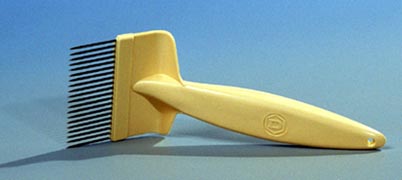
Capping scratcher...
This is one of the best tools for the hobbiest, and even the guy that has a few hundred colonies. Until you graduate up to an automatic uncapper, this is the best tool to use to release that treasure the bees have buried under those wax cappings. No sense in using one of those hot knives or planes that leave behind a smoking trail of burned slime. They never finish the whole frame in one swipe anyway, you have to drop the plane, and pick up the capping scratcher only to finish off the low spots, not real time efficient when you have to constantly switch tools to get the job done. With the scratcher alone, all you have to do is drag the tines across the cappings of the cells and it pierces them. Three passes on each side of a medium frame, and your done. Then throw the frames in your spinner and sling out the liquid gold.
You don't have to have one of those fancy heated knifes or uncapping planes, and don't bother with trying to slice off the top layer of wax capped cells with a cerrated knife. This is the best 5 dollar tool you will find to make your harvesting a pleasure.

You don't have to have one of those fancy heated knifes or uncapping planes, and don't bother with trying to slice off the top layer of wax capped cells with a cerrated knife. This is the best 5 dollar tool you will find to make your harvesting a pleasure.
Tuesday, July 05, 2005
Don't feed old honey to the bees...
I have dug up some information pertaining to old honey and heating of honey, and have posted it on both Beesource.com and Beemaster.com in response to questions by other beekeepers in the past. These questions come up on a regular basis, so I thought I'd post part of my response here, to make it easier to access and I don't have to compose it all over again.
Don't feed old honey to the bees...
Old honey contains high levels of HMF(hydroxy-methyl-furfural) which for humans, is harmless, but for bees is a poisonous drug.
New honey contains 1 to 5 mg/kg HMF. In some parts of the world it is forbidden to sell honey for human consumption with more than 40 mg/kg HMF, even though it's harmless to us.
Honey deteriorates with aging and/or heating and with this the HMF increases. Only fructose will become HMF, so depending on the variatal of honey and it's fructose content, some deteriorate faster than others.
Heating the honey will raise it's HMF contents rapidly. The longer and/or hotter it is heated, the higher the HMF levels will become. Even when honey is stored at 68 degrees it's HMF content raises 1 mg/kg per month. Heating honey to 160 degrees will raise the HMF levels to more than 30 ppm in 5 to 10 hours depending on the fructose content.
Don't feed old honey to the bees...
Old honey contains high levels of HMF(hydroxy-methyl-furfural) which for humans, is harmless, but for bees is a poisonous drug.
New honey contains 1 to 5 mg/kg HMF. In some parts of the world it is forbidden to sell honey for human consumption with more than 40 mg/kg HMF, even though it's harmless to us.
Honey deteriorates with aging and/or heating and with this the HMF increases. Only fructose will become HMF, so depending on the variatal of honey and it's fructose content, some deteriorate faster than others.
Heating the honey will raise it's HMF contents rapidly. The longer and/or hotter it is heated, the higher the HMF levels will become. Even when honey is stored at 68 degrees it's HMF content raises 1 mg/kg per month. Heating honey to 160 degrees will raise the HMF levels to more than 30 ppm in 5 to 10 hours depending on the fructose content.
Sunday, July 03, 2005
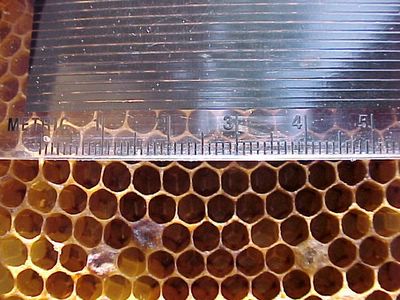
Cell measurements of foundationless frame.
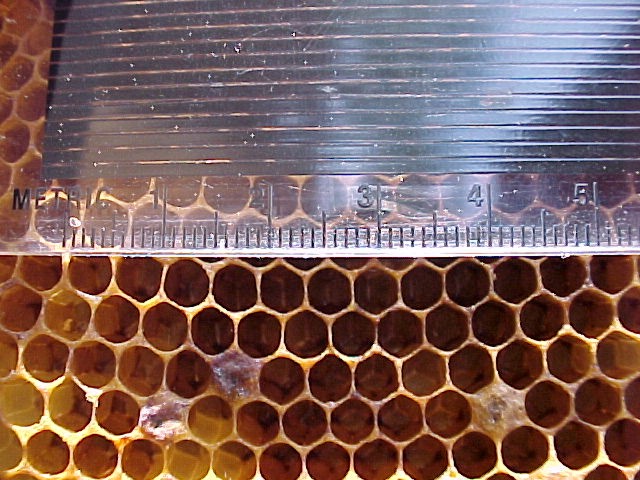
Here is a photo of the frame adjoining the primary comb in the other picture. Out of curiosity, I gathered three center frames out of a hive that had housed a swarm from late fall of 2004. The hive had cold starved over winter, and these frames were clear of most brood, allowing me to get good measurements of the majority of empty comb. I started laying the ruler on the comb to measure whether or not the size of these cells were close to that of natural sized or small cell bees, of which the comb is suppose to measure 49 centimeters across 10 cells in order to average out the cells at 4.9mm each. As I have done this often, I line up the left edge of the scale on the outside of a cell wall and look at the mark at 49 centimeters to see how close this mark comes to the nearest cell wall. The cell wall just happened to fall right on the mark, so I just chalked it up to another small cell colony, and didn't think too much about it. It wasn't until I had sent this pic off to another beekeeper and got his response, that it was brought to my attention there were actually 11 cells that fit in that span of 49 centimeters. As you see these cells average 4.4mm, which is smaller than the acclaimed size of 4.9mm for natural size bees. I immediately inserted these frames into the core of a nuc, to utilise this very small comb. I took measurements of the rest of the comb and the cells were fairly uniform as you can see in the surrounding cells in the photo, all of which were between 4.4 and 4.9mm, the frame on the other side of the primary comb measured between 4.6 and 5.1mm.
Some beekeepers say cells of this size are only drawn in the spring to early summer. The evidence says otherwise.
Too bad we had such a cold winter here in Michigan, and these girls got locked down and couldn't move over another frame or so to get the honey they needed to keep warm.
Some beekeepers say cells of this size are only drawn in the spring to early summer. The evidence says otherwise.
Too bad we had such a cold winter here in Michigan, and these girls got locked down and couldn't move over another frame or so to get the honey they needed to keep warm.
Saturday, July 02, 2005
Primary comb close up.
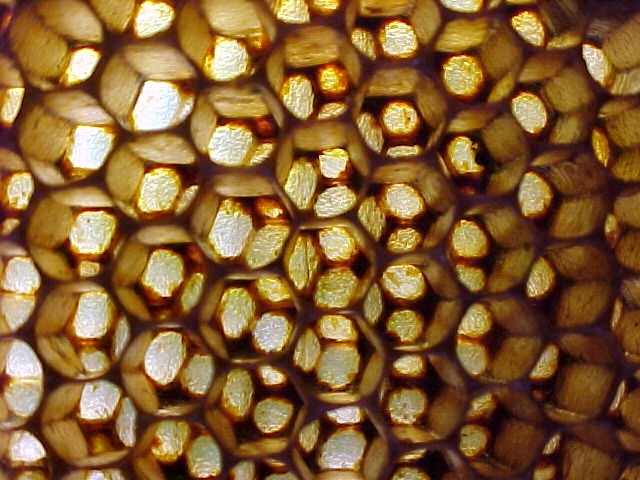
A local hobbiest and I had a discussion recently about my decals I have been selling, to label the tops of the frames with the "Housel" position. I am posting this pic and info for him to see what I have documented from my own observations. Maybe the rest of you will find this interesting as well... This is a close up of the primary comb, notice the tops of the cells are flat. This is not the typical construction of the comb structure, but rather what some people have documented as the first comb to be drawn in the center of the brood nest, and labeled as the primary comb. There are two very distinct characteristics of the primary comb, the first being one of the flat sides of the hex shape of the cell being at the top, typical cells have a corner of the cell at the top of the cell structure to give it more structural integrity. The second very distinct characteristic of the primary comb, is the position of the "Y" that you can see shining through the bottom of the cells in the center of this pic. In a typical honeycomb cell the "Y" looks like just that, a "Y", but by viewing this frame from the opposite side, the "Y"s will then be inverted. Some people claim that on the primary comb this "Y" is turned 90 degrees, but I believe it is a much simpler adjustment that the bees make. To acquire this sideways "Y" that appears in the photo, the bees can simply adjust their building of this cell structure by a mere 30 degrees, either clockwise or counter-clockwise and the "Y" will appear to have been tilted 90 degrees.
Monday, July 26, 2004
Lesson #306: Never believe your hive won't swarm..
This hive started out as a split containing four frames of brood and multiple swarm cells. After the virgin queen emerged she laid one batch of brood and quit. I was stumped as to what to do, so I just waited and checked on them on a regular basis hoping they were just honeybound and the queen would start laying again soon. A few weeks pass and I find a Supersedure cell, giving me the indication that the queen had not been well mated therefore they will supersede her, no problem.
I failed to mention that these girls had not drawn out all ten frames of foundation in their first deep, but they were close to drawing out 7 therefore I added a second deep pulling two frames of honey and pollen up top to encourage them to move up and draw out those frames and realize they have plenty of room, just in case those Supersedure cells are swarm cells. Supposedly swarm cells are formed on the bottom of frames and Supersedure cells are drawn out from the sides of the frames about half way up, right???
Wrong... I checked in on them today and they had taken off without my permission. Obviously they did not appreciate the wonderful environment I had provided for them, go figure...
I failed to mention that these girls had not drawn out all ten frames of foundation in their first deep, but they were close to drawing out 7 therefore I added a second deep pulling two frames of honey and pollen up top to encourage them to move up and draw out those frames and realize they have plenty of room, just in case those Supersedure cells are swarm cells. Supposedly swarm cells are formed on the bottom of frames and Supersedure cells are drawn out from the sides of the frames about half way up, right???
Wrong... I checked in on them today and they had taken off without my permission. Obviously they did not appreciate the wonderful environment I had provided for them, go figure...
Subscribe to:
Posts (Atom)